Travertine Coffee Table Ideas: 16 Styling Looks + How to Choose Size, Finish and Care
Warm, porous and quietly sculptural, travertine makes a living room feel grounded. Here are sixteen ways to style a travertine coffee table, plus the size, finish and care basics to know before you buy.
A travertine coffee table is the kind of piece a room gets built around. The stone is warm rather than cold, its pores and veining give it texture, and it pairs naturally with bouclé, linen, jute and oak. Below are sixteen looks, from fluted bases to raw-edge blocks, and at the end a short guide to choosing the right size, finish and care routine. If you are planning the whole room, start with our guide to mixing bouclé, travertine and warm wood.
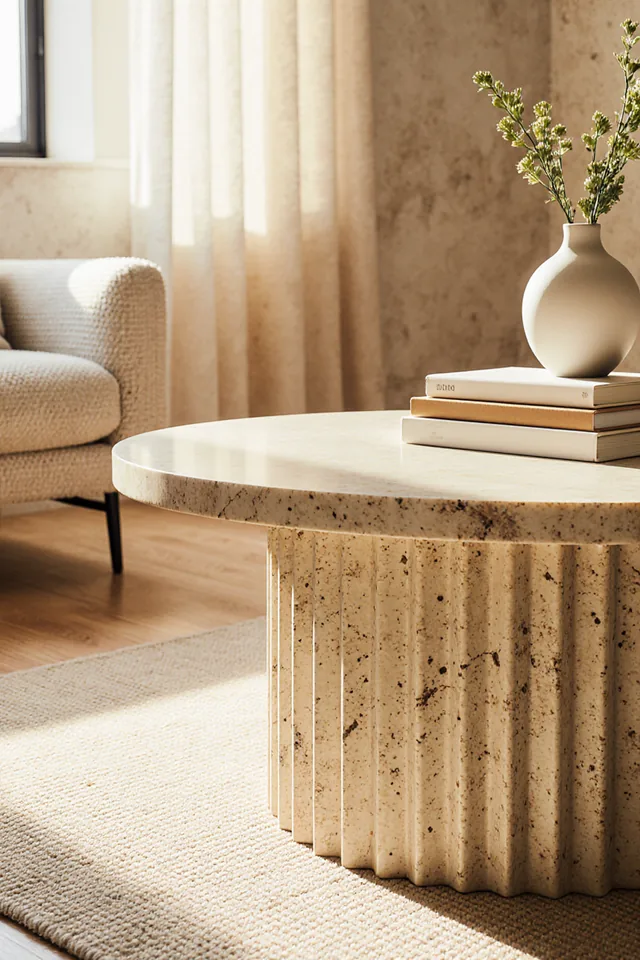
1. Choose a fluted base for quiet drama
A fluted pedestal turns a simple round top into the sculptural centre of the room. Low side light runs down the grooves and makes the stone look carved rather than cut. Keep the styling to one stack of books and a single vase so the base stays the focus.
Steal this look
Base a fluted drum under a round, rounded-edge topStyling three books and one round vase with a few stemsPartner a cream bouclé armchair and a flat-weave rug
Pro tip
Place it where morning or late-afternoon light hits from the side. Flutes need raking light to read; under a ceiling light they flatten out.
Avoid
Crowding the top. A busy surface competes with the base, and the base is the reason to buy this table.
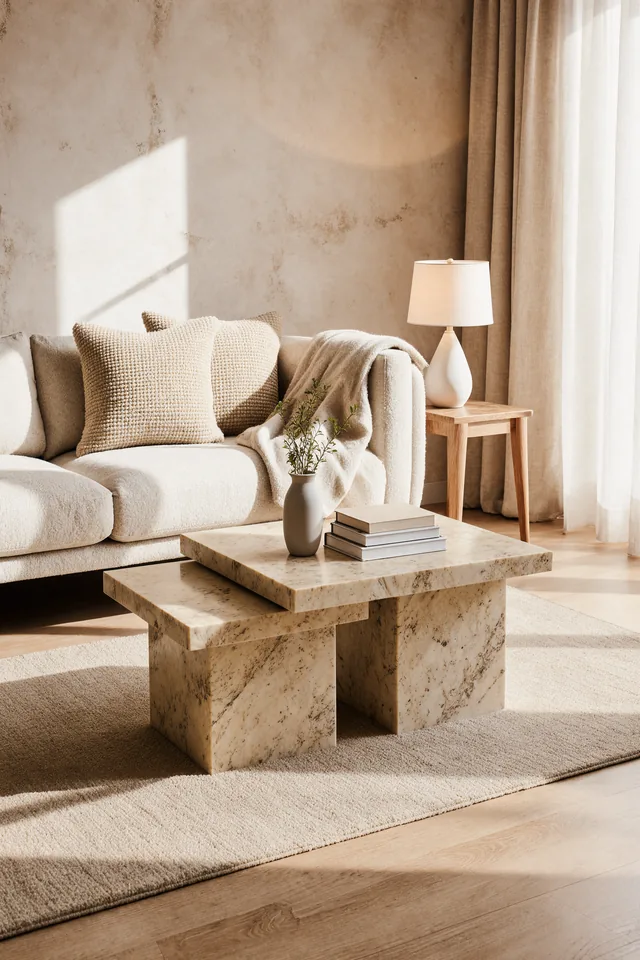
2. Stagger two nesting slab tables
Two square slab tables at different heights, one sliding under the other, give you the presence of a big stone table with more flexibility. Pull the lower one out when guests come over, push it back when you need floor space.
Steal this look
Tables two square slabs, one taller than the otherLayout offset so both tops showPalette cream sofa, oatmeal knit cushions, oak side table
Pro tip
Style only the higher table. Leave the lower one bare so the stepped silhouette stays crisp.
Avoid
Lining the two tables up edge to edge. Overlapped at an angle they look intentional; side by side they look like one table cut in half.
The Sunday Edit
One warm room in your inbox, every Sunday.
Thank you. Please check your inbox to confirm your subscription.
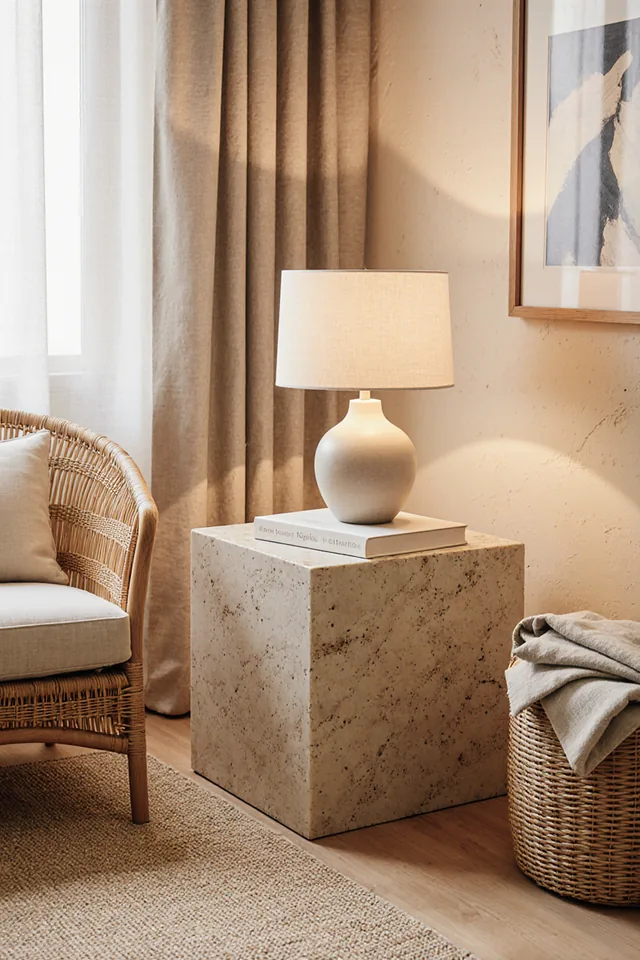
3. Use a travertine cube as a side table
If a full stone coffee table is too much for your room, start with a cube. Next to a rattan chair it brings the same warmth and weight at a fraction of the footprint, and it works as a lamp table, a plant stand or an extra seat.
Steal this look
Cube a solid travertine block at arm heightLight a round ceramic lamp with a linen drum shadeTexture rattan chair, woven basket, washed linen throw
Pro tip
Set the lamp on a book. It lifts the shade a little, so the light falls on the chair rather than the cube.
Avoid
Pairing the cube with another heavy stone piece right beside it. One block per corner is enough; let rattan and linen soften the rest.
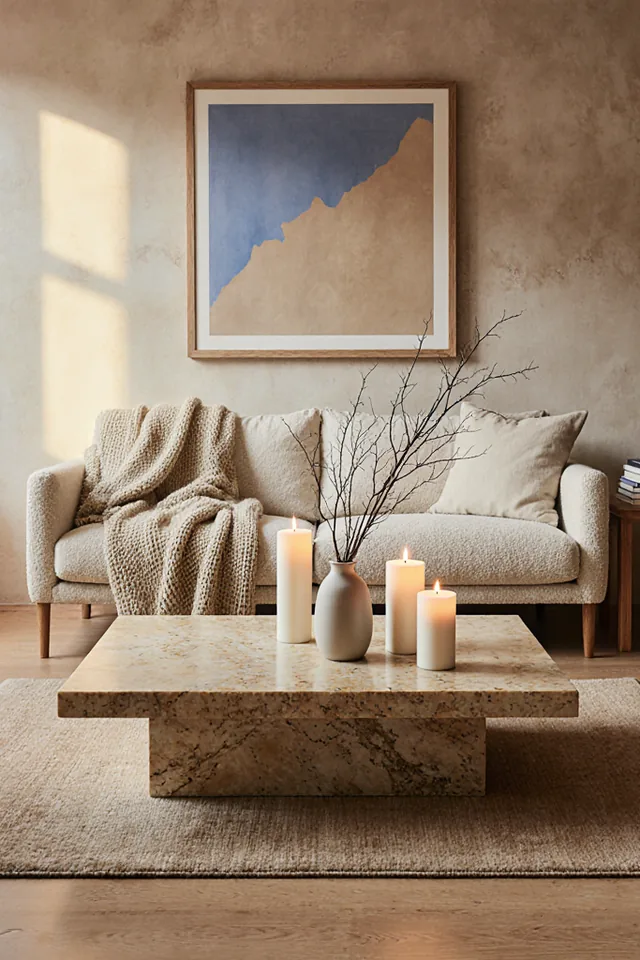
4. Go low and square with a slab top
A low, wide square table makes a sofa feel deeper and the room more relaxed. Three pillar candles and a vase of bare branches are all it needs. The stone picks up the candlelight and glows warmer in the evening than it does by day.
Steal this look
Table a thick square slab on a recessed plinthStyling three ivory pillar candles and one vase of branchesWall one large framed print centred above the sofa
Pro tip
Keep the table close to seat height. Living Spaces suggests matching the sofa seat or staying within an inch or two below it; most coffee tables run 16 to 18 inches high.
Avoid
Placing candles near the throw or the curtains. Group them in the middle of the slab, well away from fabric.
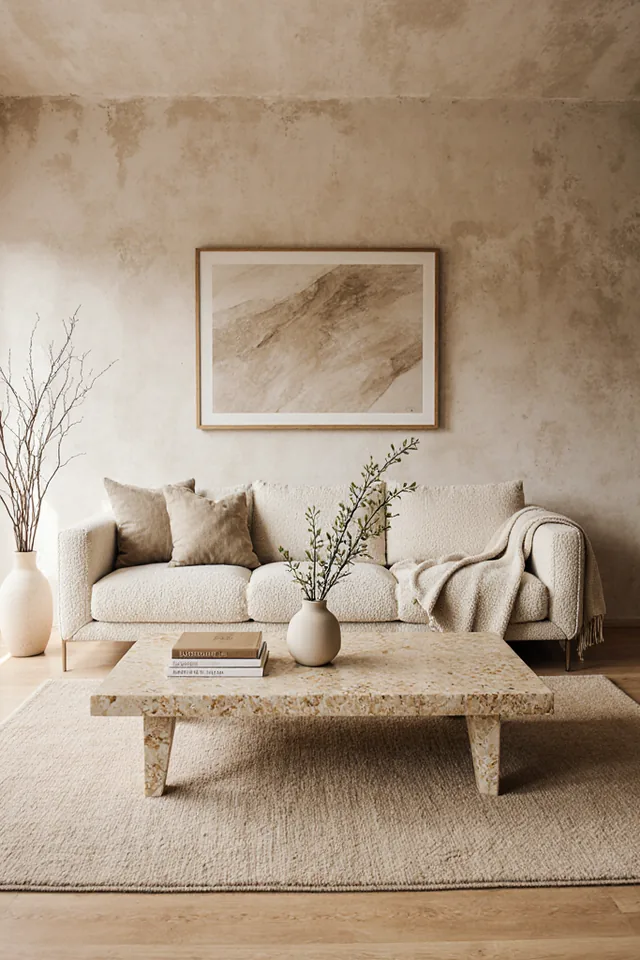
5. Lift it on tapered stone legs
Legs change everything. With floor visible underneath, a stone table looks lighter and the room looks larger. Tapered legs in the same stone keep the piece unified, and the speckled pattern ties in with a mottled plaster wall.
Steal this look
Shape a thick rectangular top on four tapered legsSurface a honed, speckled finish rather than polishedBackdrop limewash or plaster walls in sand and cream
Pro tip
Choose a honed finish for a coffee table you actually use. Tile Outlets describes honed travertine as smooth, ranging from matte to a satin sheen, so it hides fingerprints better than a high polish.
Avoid
Mixing in a second busy pattern. A speckled stone and a patterned rug fight each other; keep the rug plain and textural.
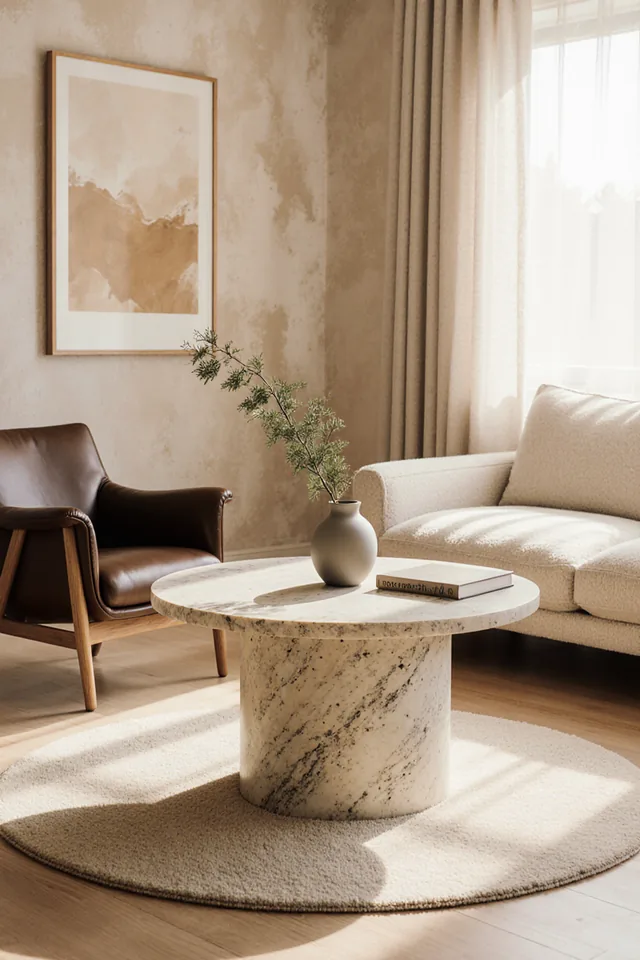
6. Pair a round pedestal with a round rug
A round table on a round rug creates a calm island in the middle of the room. The brown leather armchair is the useful contrast here: smooth, dark and warm against pale, porous stone.
Steal this look
Table a round top on a narrow cylinder pedestalRug a round, low-pile rug larger than the tableContrast one leather or dark wood chair
Pro tip
Round tables are easier to walk around than square ones, which helps when the seating is arranged on two sides rather than facing one sofa.
Avoid
A round rug that is barely wider than the table. Give it enough margin that the rug frames the table instead of looking like a coaster.
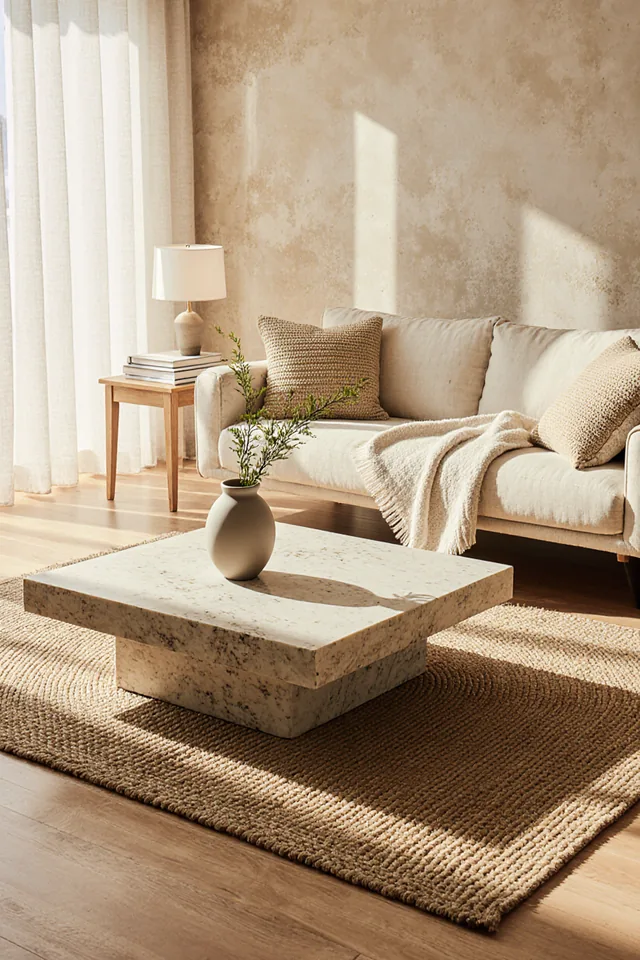
7. Pick a stepped plinth base
A thick square top on a smaller square plinth makes the table appear to float. The shadow line between the two layers adds depth without any extra decoration, which suits a sunny, pared-back room.
Steal this look
Form a heavy square top on a recessed square plinthRug chunky natural juteAccents one cream vase, a knit throw on the sofa
Pro tip
Measure the walkway before you buy. Living Spaces recommends roughly 14 to 18 inches between the sofa and the coffee table, close enough to reach a cup, far enough to pass.
Avoid
Choosing a square table for a long, narrow sofa. Square tables suit square seating groups and deep sectionals; long sofas want a rectangle.
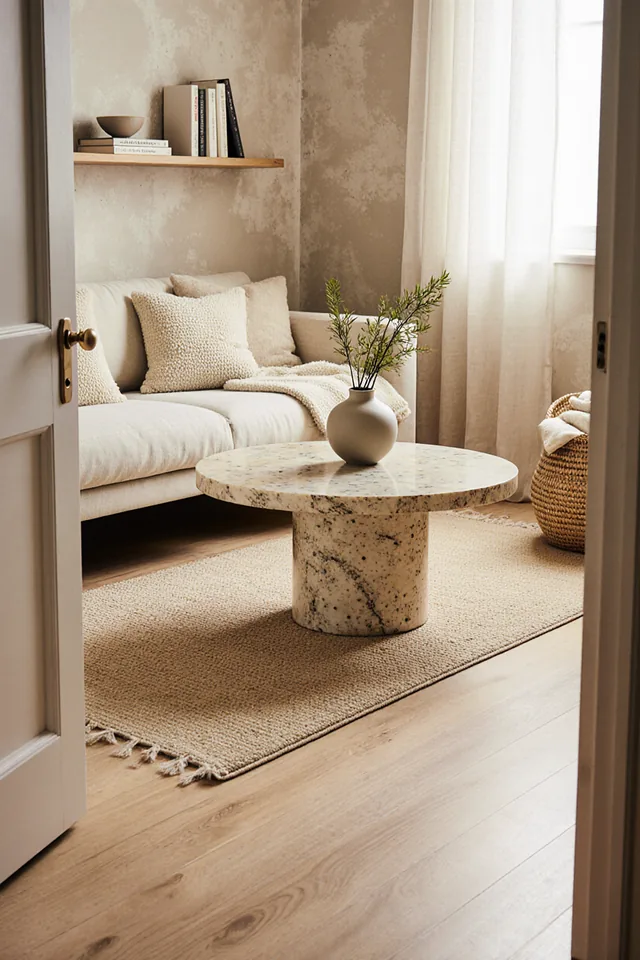
8. Go round in a small living room
In a compact room, a round table with a single pedestal takes up less visual space than four corners and four legs. Nothing sharp to bump into, and the open floor around the base keeps the room feeling bigger.
Steal this look
Table a round top on one central pedestalSoftness bouclé cushions and a knit throw on a linen sofaStorage a woven basket for throws in the corner
Pro tip
Keep the top clear except for one vase. In a small room, an empty surface reads as breathing space. More small-space ideas are in our guide to cozy small apartment decor.
Avoid
A heavy rectangular table in a room you walk straight through. Corners in a walkway are what make small rooms feel cramped.
9. Balance stone with a woven pouf
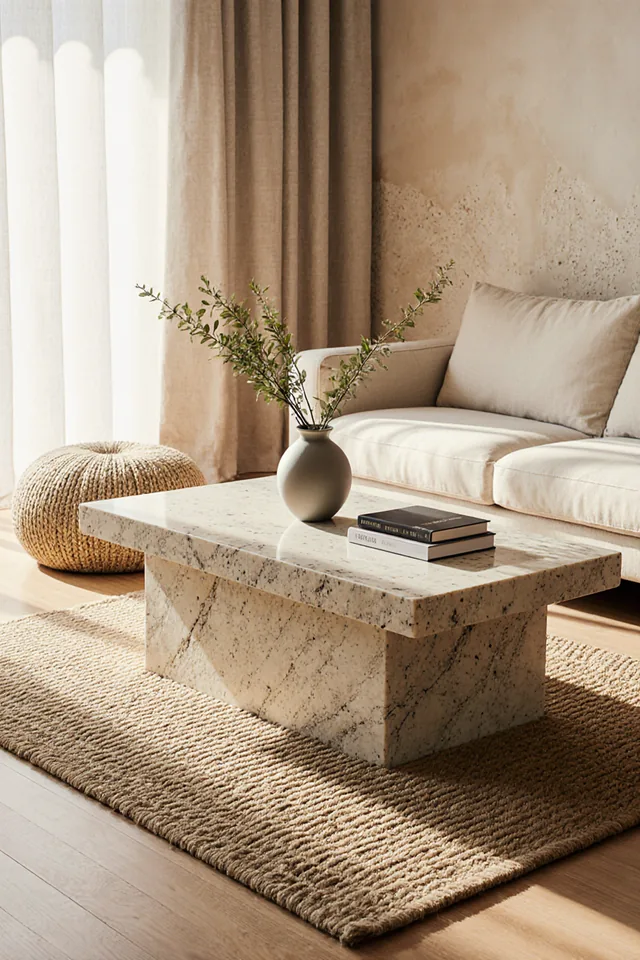
A solid rectangular slab is heavy by nature. A round woven pouf next to it adds softness, extra seating and a second natural texture, so the stone feels grounded rather than bulky.
Steal this look
Table a rectangular slab on a full-width stone baseSeat a round woven or knitted poufLayers jute rug, linen curtains, cream sofa
Pro tip
Repeat a material three times. Here jute appears in the rug and the pouf, and stone in the table and vase, which is what makes the room feel calm.
Avoid
Adding a second stone piece of similar size. One solid stone mass per seating area is enough.
10. Choose polished for a soft sheen, and use coasters
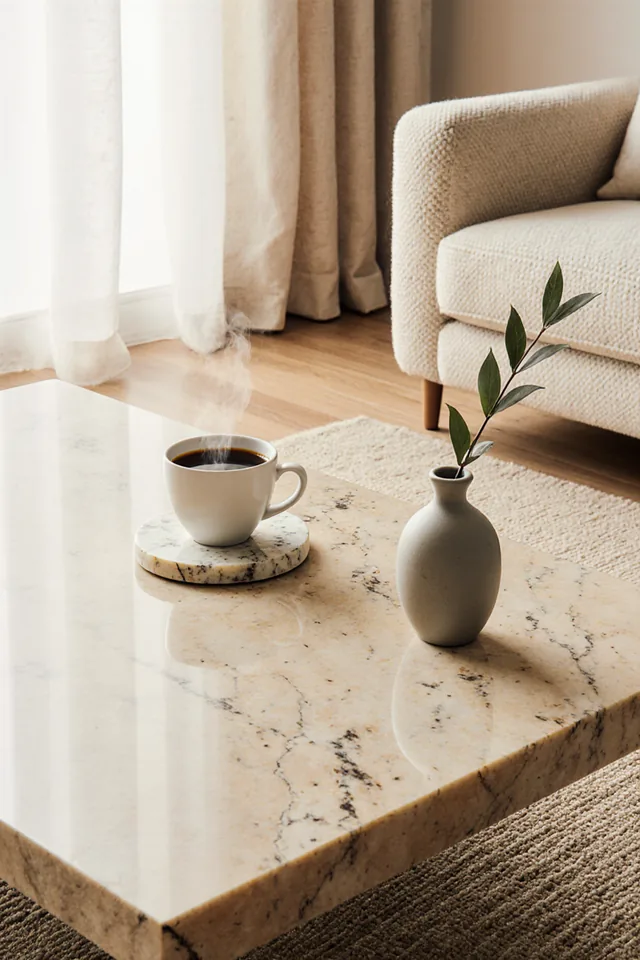
Polished travertine catches light and looks almost glassy. Tile Outlets notes polished travertine is usually filled, so the surface is smoother and more uniform. It is beautiful, but it shows marks more readily than a honed finish.
Steal this look
Finish polished and filled for a smooth, reflective topCoaster a marble or stone coaster under every cupAccent a small matte vase to contrast with the shine
Pro tip
Travertine is a calcium-carbonate stone, so the Natural Stone Institute warns that acidic drinks and cleaners can etch it. Coasters under glasses, especially wine and citrus, are the simplest protection.
Avoid
Wiping up a spill. Blot it with a soft cloth instead, so you do not spread it across the stone.
11. Layer it over a round jute rug
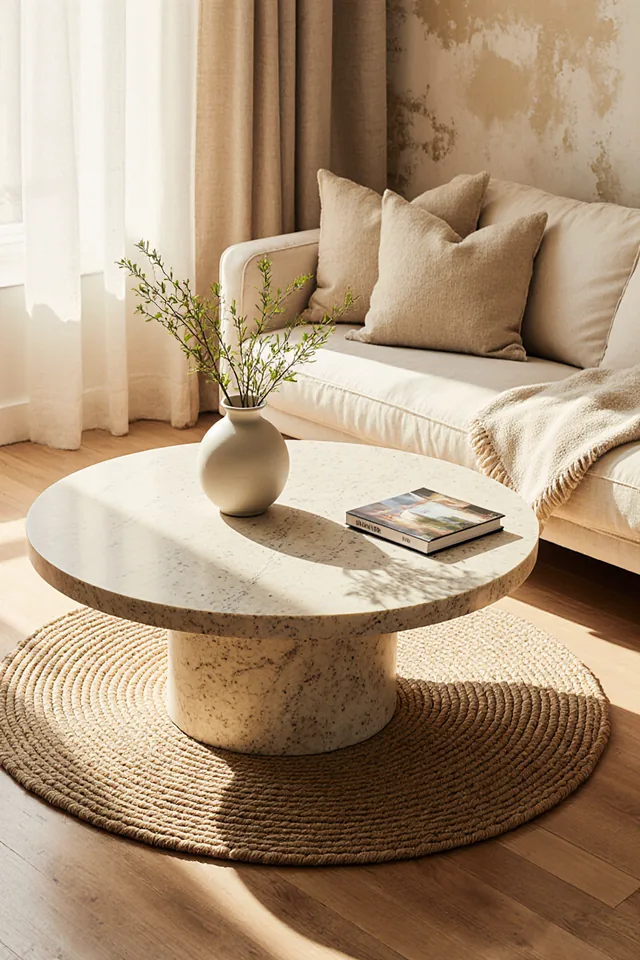
A braided jute rug under a round table adds a ring of texture that repeats the shape of the top. It is an easy way to make a stone table feel softer and more casual.
Steal this look
Rug round braided jute, wider than the tableTable a round top on a thick cylinder baseStyling one art book and one round vase
Pro tip
Turn the art book so its cover faces the sofa. It is a small detail, but it makes the table look styled for the people sitting there, not for a camera.
Avoid
Jute directly under a heavy table on a hard floor without a rug pad. A pad stops the rug creeping and protects the floor.
12. Soften the room with an oval top
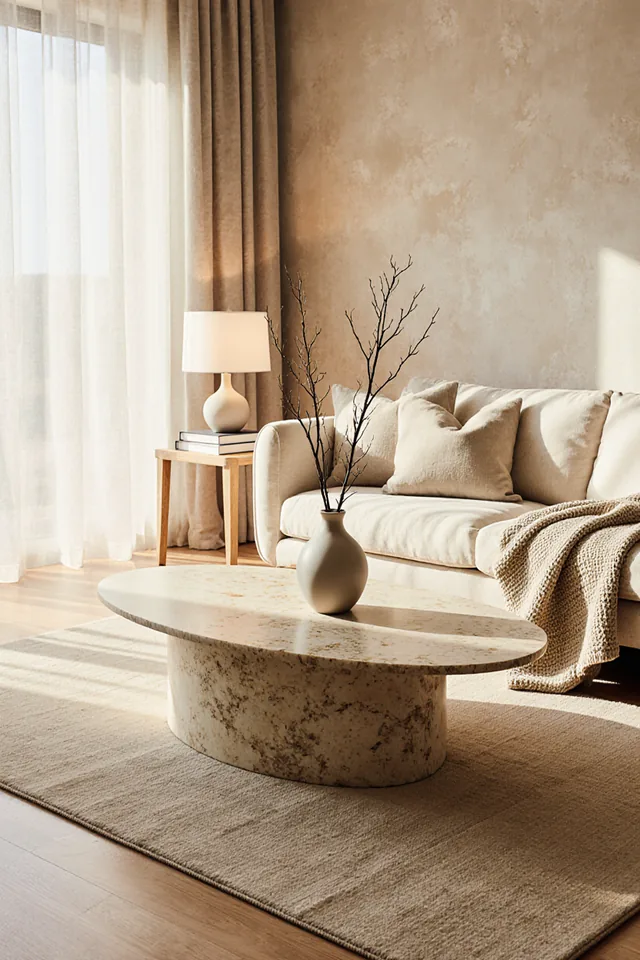
An oval top has the length of a rectangle and the softness of a circle, so it works in front of a long sofa without hard corners. Bare branches add height and a seasonal note without any colour.
Steal this look
Shape an oval top on a matching oval pedestalHeight a tall vase with bare branchesLight a lamp on an oak side table at the sofa arm
Pro tip
If you are torn between round and rectangular, choose oval. It follows the length of the sofa and still lets people move around it easily.
Avoid
Branches that block the view across the room. Keep them sparse and to one side of the table.
13. Size it to two thirds of the sofa
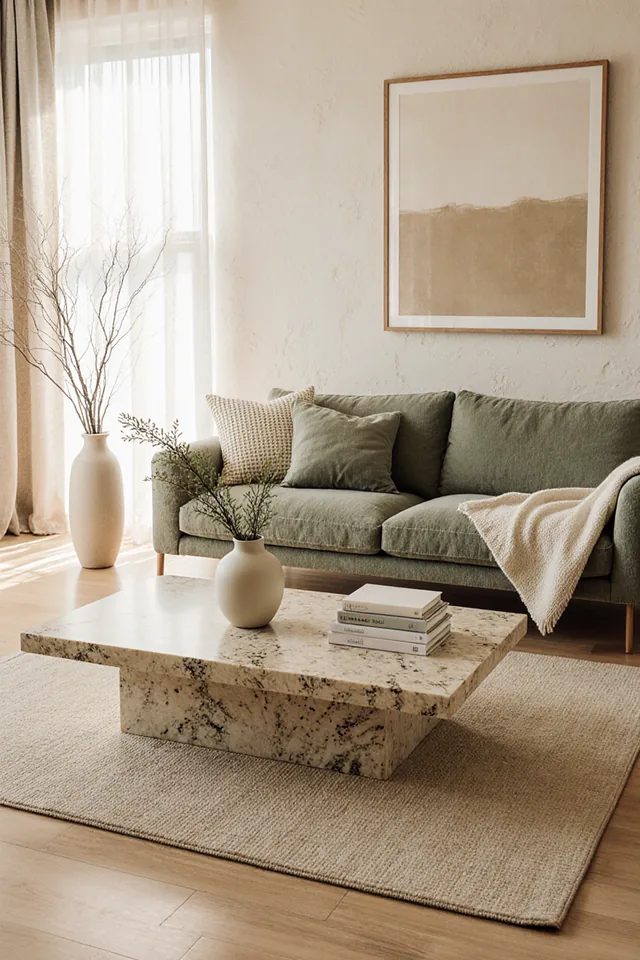
This is the proportion to copy. The table runs about two thirds of the sofa’s length, so it is reachable from every seat without crowding the arms. A sage green sofa shows that travertine works with colour, not only with cream.
Steal this look
Size about two thirds the length of the sofaColour a sage green sofa with oatmeal and olive cushionsHeight a tall floor vase with branches at one end
Pro tip
Living Spaces’ rule of thumb: a coffee table about two thirds the length of your sofa. Measure the sofa first, then shop for the table.
Avoid
A table as long as the sofa. It blocks access at both ends and makes the seating feel boxed in.
14. Corral the top with a wooden tray
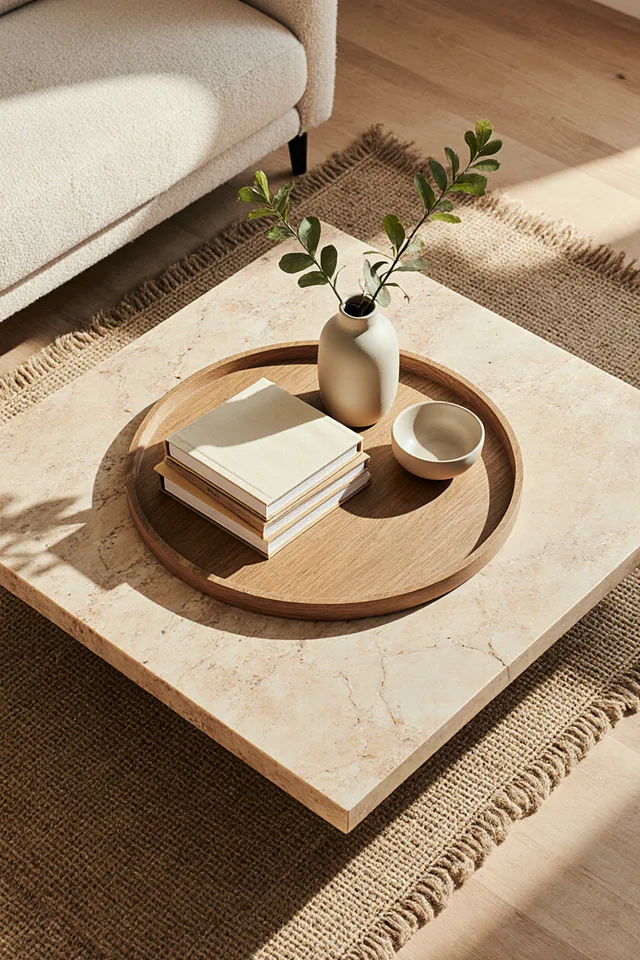
A round oak tray gives a square stone top a focal point and keeps small things in one place. Warm wood against pale stone is a classic organic modern pairing.
Steal this look
Tray round, in oak, with a low rimInside books, one vase of greenery, a small bowl for keysRug fringed jute or sisal
Pro tip
A tray also protects the stone. Anything that might leave a ring, like candles, plants or cups, sits on wood instead of travertine.
Avoid
Filling the tray to the rim. Three objects with space between them look curated; six look like clutter.
15. Let a raw, chiseled edge do the talking
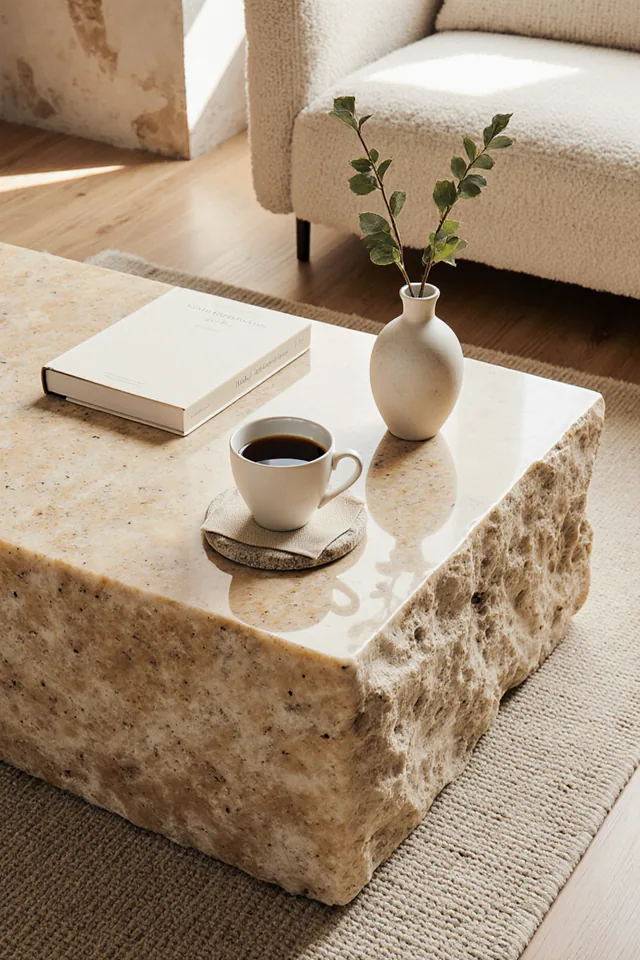
A smooth top with a rough, chiseled side shows both faces of the stone at once. The open pores and pitted edge are the natural texture of travertine, and they make the table look like it was cut from a single block.
Steal this look
Edge polished top, raw chiseled sidesMass a deep block rather than a thin slabStyling one book, one cup, one stem
Pro tip
Unfilled travertine keeps its natural holes open. Tile Outlets explains that filled stone looks smoother and more uniform, while unfilled shows more of the stone’s texture. Choose based on how much texture you want to see.
Avoid
Cleaning a raw edge with vinegar or any acidic or abrasive cleaner. The Natural Stone Institute recommends a neutral cleaner or mild soap, then rinsing and drying.
16. Mix travertine with dark walnut
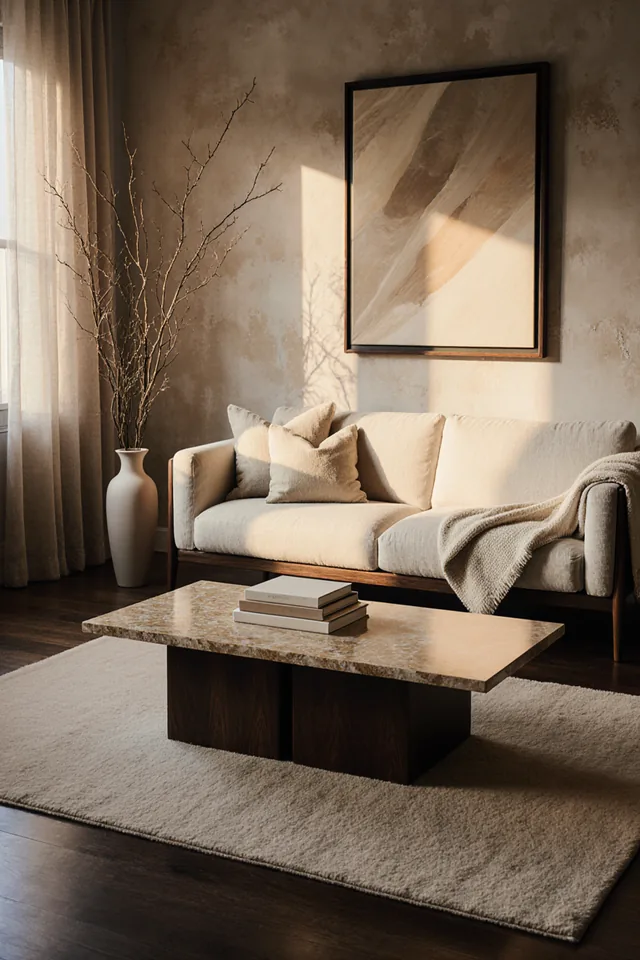
Travertine does not have to be pale and beachy. A travertine top on dark walnut bases, a dark floor and low evening light make the stone look richer and more golden.
Steal this look
Table travertine top on two dark walnut blocksFloor dark stained wood with a cream rugMood a tall vase of branches, large abstract art, low light
Pro tip
Repeat the dark wood once more in the room, like the sofa frame or a picture frame, so the base does not look like an isolated contrast.
Avoid
Leaving it under one bright overhead light. Travertine looks its warmest with lamps and side light.
Before you buy: size, finish and care
Size. Living Spaces suggests a coffee table about two thirds the length of the sofa, roughly level with the seat or an inch or two lower (16 to 18 inches high is standard), with about 14 to 18 inches of space between the table and the sofa. Treat these as starting points and check them against how you actually use the room.
Finish. Honed travertine is smooth with a matte to satin sheen. Polished is glossy and usually filled. Tumbled has softened, aged edges. Filled stone has its natural holes filled for a uniform surface; unfilled leaves them open for more texture. (Source: Tile Outlets.)
Care. According to the Natural Stone Institute, travertine and other calcium-based stones are sensitive to acids. Avoid lemon, vinegar and acidic or abrasive cleaners; clean with a neutral cleaner or mild soap, then rinse and dry. Use coasters under glasses and trivets under hot dishes, and blot spills rather than wiping them. Sealing makes the stone more stain resistant but not stain-proof, and etching usually needs professional polishing to remove.